
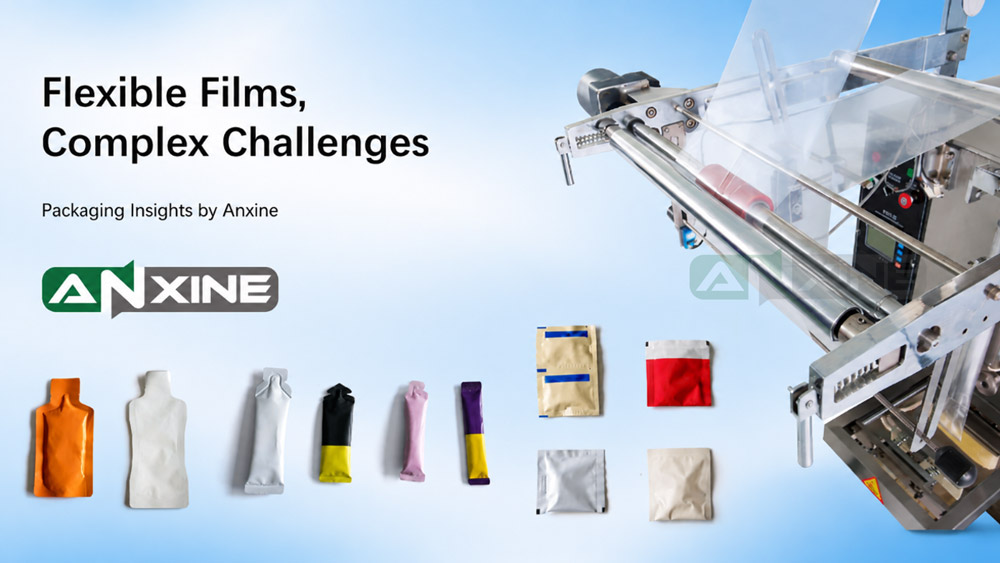
The right roll film should not only protect the product. It also needs to work well with an automated packaging line. In actual production, the film itself may be suitable for the product, but problems can appear once it runs on the machine. These issues may seem minor, but they can affect the efficiency of the entire automated line. That is why roll film selection should also consider how well the film will perform in real production.
How Roll Film Works in an FFS Packaging Machine
Flexible packaging equipment generally falls into two main types. One uses premade bags, while the other uses roll film and is known as a Form-Fill-Seal (FFS) packaging machine. Roll film is used on FFS machines. Before looking at the factors that may cause roll film to be incompatible with a packaging machine, it is helpful to understand how an FFS machine works.
 Once the roll film is properly installed, it is unwound by the film unwinding system. It then passes through several stations, such as a printer unit (if equipped), film cutting unit, forming unit, sealing unit, and final cutting unit. The finished sachets are then discharged from the machine. This is the basic workflow of an FFS packaging machine.
The exact structure and process sequence may vary from one machine to another, but the overall principle is similar. By using flexible packaging film with FFS machines, manufacturers can produce various bag formats for sachet packaging.
What Causes Roll Film Issues on Packaging Lines?
Four main factors account for most roll film issues on automated packaging lines. Understanding and addressing them in advance helps reduce downtime and improve production efficiency.
- Film and machine specification mismatch
- Print design and eye mark detection issues
- Heat-sealing performance and machine setting mismatch
- Unstable film tension and web guiding, and speed mismatch
Below is a detailed look at these four factors.
Key Factors Affecting Roll Film Performance on Packaging Lines and How Can We Prevent Them
1. Film and machine specification mismatch
First, the roll film must match the machine specifications to run smoothly. This includes factors such as film width, roll diameter, core size, and repeat length. For example, if the roll diameter is too large or too small, the film may not fit properly on the unwinding system.
For this reason, key machine parameters should be confirmed before purchasing roll film. Likewise, when purchasing a packaging machine, it is important to make sure the machine can run the selected roll film.
2. Print design and eye mark detection issues
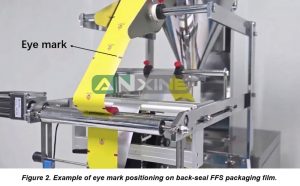 The photoelectric sensor on an FFS packaging machine can read the eye mark on the roll film. This helps the machine control sachet length. If the eye mark does not meet the machine’s detection requirements, packaging accuracy may be affected. Common issues include a mark that is too small, too light, or placed at the wrong interval. For this reason, it is best to run a machine trial before ordering roll film in large quantities. The following steps can be used as a reference:
- Confirm the eye mark requirements with the packaging machine supplier.
- Have the printing supplier design and print the film according to those requirements.
- Produce a small batch of sample film first.
- Test the sample roll film on the packaging machine.
- Make sure the machine can read the eye mark correctly, control the bag length, and cut in the right position.
- Once the trial is successful, proceed with full-scale production.
3. Heat-sealing performance and machine setting mismatch
Roll film is not just a single layer of plastic. It is usually made by combining several different materials. To create a strong seal without damaging the film, the machine’s sealing temperature, pressure, and sealing time must be properly controlled.
During sample testing, a sealing test can be done at the same time. The machine manual and the reference temperature from the film supplier can be used to test and adjust the sealing temperature, pressure, and sealing time.
4. Unstable film tension and web guiding, and speed mismatch
To keep roll film running smoothly, the film tension should be set at a proper level. The film should not be too tight or too loose. The machine’s web guiding system should also work correctly so the film can move in a stable path. Film running speed should match the following steps, including bag forming, filling, sealing, and cutting. If the speed is not properly matched, production may be affected.
The End
The right packaging machine and the right roll film work together to keep the packaging line running smoothly. To learn more about flexible packaging solutions, please visit: https://www.anxine.com/