
Many components and process variables can affect the ultimate quality of a finished product including the base stock itself. Consider paper. When specifying paper the printer or converter must take into account paper strength, base sheet uniformity, moisture content, smoothness, gloss, ink receptivity, brilliance, whiteness and coating specifications and perhaps much more; it depends of course on what is too be applied to the paper and what purpose the paper will be used for: labels or packaging or something else.
 Printers and converters often say that given the right circumstance they favour paper over film. Paper is perceived as being the most environmentally acceptable material and there are generally fewer variables too contend with. That may or may not be the case. It is fair to say though that there are still enough compatibility issues and other disruptive problems to warrant care. The control of the web and precise tension regulation is critical. Process transients and inconsistencies affect registration, uniformity of inks and coatings, colour and graphics. By association productivity yields will decrease while waste will increase.
Based on the job requirements the printer or converter that prints, coats or laminates might focus on the strength, moisture resistance, opacity, etc., or the possibility for modification or inclusion in with another substrate or substrates: i.e. flexible pouches.
The strength of the paper is of course critical when printing or converting and adding value. It must survive the various converting processes and in web fed processes the paper must be strong enough to withstand the rigours of unwinding and rewinding. Base uniformity is critical in both cross machine and longitudinal direction.
Moisture content varies enormously from roll to roll, which may cause difficulties when feeding paper into a printing machine, coater or another process machine. Too much moisture can cause problems such as curl and can affect how the paper unrolls during processing.
Brilliance and whiteness of paper are regarded as essential for some applications. Whiteness, depending on the opacity of the ink can affect colour appearance. The gloss of the paper can have a significant affect on ink gloss itself. However, not only does whiteness of stock vary from supplier to supplier it also varies across different rolls of the same stock. If inks of higher density are being used any variation in whiteness will be hidden. This won’t be the case with certain inks used with flexo for example.
Helpfully a substrate can give visual clues as to what too expect. For instance, if the paper is glossy, normally it is a clay-coated product. A higher level of gloss gives the printer a better hold out of inks and theoretically better colour representation.
 The ways in which a paper is finished or the way in which the paper is clay-coated can affect ink receptivity. If a paper is very porous and if at the microscopic level the fibres are not tightly locked, the ability to achieve a high level of gloss finish with an ink will be more difficult than if the fibres of the paper are locked together and the paper has a smooth surface.
Paper manufacturers continue to develop new products or refine existing ones to compete with other materials and to meet environmental objectives. The various means of treatment, often involving optical brighteners and synthetic polymers provides significant performance and final product benefits but can cause ink/coating and sometimes, drying problems.
Consistency of colour is critical and this of course applies whether the substrate being printed upon is paper or another medium. Consideration must be given to the visual properties of ink, which include: colour, transparency or opacity and gloss.
If we think seriously about colour we are mostly thinking of hue or shade; the strength or saturation, or chroma. The amount of pigment used can affect colour strength, while the type of vehicle used influences the hue and value of the ink colour. The colour of the substrate and the drying or absorption properties also impacts on final print colour, graphics and text.
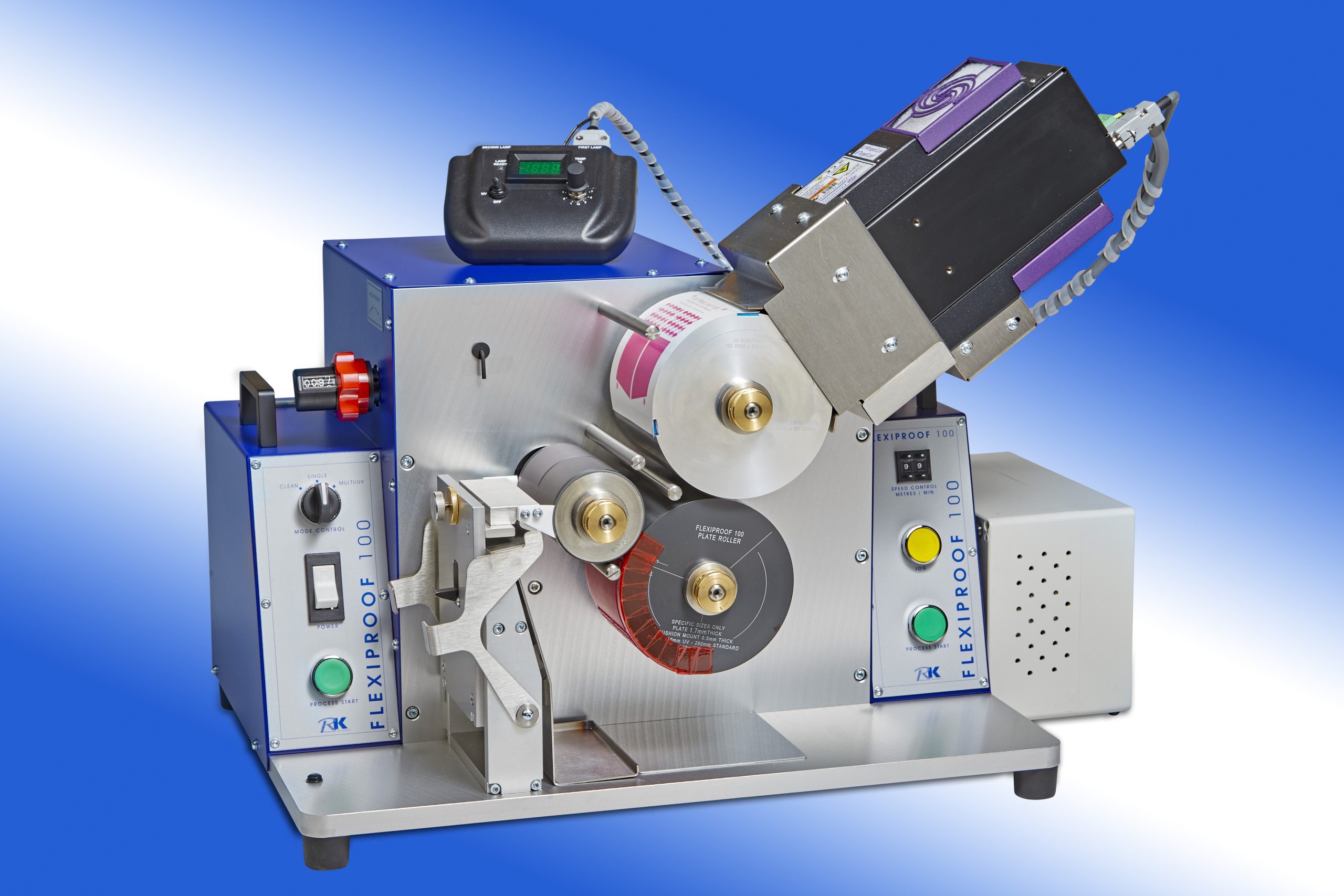
Monitoring and quality control equipment such as the FlexiProof family of colour communication or proofing devices enable users to highlight and work towards resolving issues surrounding the use of flexographic inks and substrates. Tests such as durability, flexibility, scratch and wear resistance; chemical resistance and much more can be carried out. At the same time regular colour matching samples can be made to ensure colour meets agreed standards and without the high levels of waste that would be made using a production press.
For UV flexographic printers and converters and for consumable producers the FlexiProof UV enables users to easily simulate real world UV flexographic print conditions in the laboratory, pre-press department or elsewhere, economically and quickly without the need to resort to using a conventional full size production printing press.
The FlexiProof UV and a version that incorporates LED or light emitting diodes are self contained integrated devices that enables users to print and cure seamlessly, enabling the user to detect blemishes and particularly pinholes which cannot be detected with a conventional UV conveyor.