
Rising material, labour and transportation costs are putting new pressure on packaging operations. The right combination of process improvement and automation can increase throughput while reducing material use, handling, waste and safety risks.
By Ray Wilson, senior director, Packaging Automation, SuppyOne
Packaging operations are being squeezed from several directions at once. Across the industry, manufacturers have faced hundreds of price increases affecting virtually every type of packaging material. That alone creates a strong incentive to use less material and use it more efficiently.
Labour remains another pressure. Manufacturers may struggle to find enough people to meet production requirements, and temporary labour can introduce additional training needs and process variability. Transportation adds another layer: unnecessary weight and package volume can increase storage, handling and shipping requirements.
 At the same time, companies are being asked to increase output, improve safety and reduce waste. Sustainability expectations extend from the amount of packaging used to transportation efficiency and, increasingly, whether the end user can dispose of packaging through normal curbside recycling.
Taken together, these pressures make packaging an increasingly important area for operational improvement. The basic objective is simple: do more with less. More throughput and consistency with less material, labour, handling, space and waste.
Automation can be an important part of that equation. But the best place to start is usually not with a machine. It is with the process.
Start with the process
A worker hand-taping boxes or wrapping pallets may provide an obvious automation opportunity. But focusing too quickly on that individual task can miss larger problems elsewhere in the operation.
A packaging process includes receiving and storing materials, moving and staging products, packing, protecting, sealing, labelling, palletising and shipping. A bottleneck at one point can create delays, additional handling or labour requirements somewhere else.
The first step is therefore to observe how the entire process works. Where does product stop? How often is it touched or moved? Where is labour concentrated? Where does material accumulate? What equipment already works well? Where do space, ergonomics or safety become problems?
Existing equipment may remain part of the solution. A conveyor, crane or other machine that performs its function effectively can often be incorporated into a redesigned process rather than replaced.
The resulting solution may include case erecting and sealing, stretch wrapping, strapping, labelling, conveying or robotics. It may also include a different packaging material, a redesigned workstation or a change in product flow.
The equipment should follow the application.
Two very different operations, similar lessons
Two SupplyOne customer projects illustrate the range of packaging automation from relatively low-volume work involving very large, heavy industrial products to high-speed, high-volume consumer packaging. The technologies and operating conditions are very different, but both show why the solution has to be built around the specific process.
Large Industrial Pumps
One manufacturer produces pumps weighing hundreds to approximately 1,000 pounds. Its traditional packaging process relied heavily on custom wood crates fabricated in an in-house wood shop.
That required lumber inventory, floor space and employees using saws, nail guns and other tools. The products themselves also required substantial handling as workers lifted, repositioned and worked around the pumps while adding components, inspecting them and preparing them for shipment.
The redesigned process addressed the packaging and the movement of the product together. Three standardised pallet sizes replaced much of the one-off crate fabrication, with corrugated packaging incorporated into the new approach.
A conveyor system moved the pumps through work areas where employees could add components and conduct quality checks with less lifting and repositioning. An existing crane remained at the beginning of the line because it still served a useful purpose, including providing time for painted products before they entered the new process.
Downstream, conveyors moved products to a lowering station, strapping operation and outbound handling area. Ergonomic decking and platforms improved access, while a pick-to-light system helped workers select the correct labels, screws and other components.
The changes cut packing time by roughly 50 per cent, reduced staffing in the area by at least two positions and increased throughput by approximately one-third to one-half. They also reduced manual handling and safety exposure while improving accuracy.
Jam production
A second customer faced an entirely different challenge. Its semi-automatic line required at least seven workers positioned throughout the process.
Two people were needed around filling simply to top off jars and wipe product from the threads. Other employees applied lids and manually inverted each jar to help form the seal. The product then passed through labelling equipment that was poorly suited to the application before reaching a large table for cooling.
That cooling step took about 45 minutes, contributing to a stop-and-start process.
The redesigned line connected activities that had previously been separate. Filling, capping, cap torquing, inversion, labelling and date coding were integrated, followed by in-line cooling.
Staffing fell to roughly one or two people loading at the beginning, a general operator and one or two employees at the end. Cooling that had taken about 45 minutes was reduced to seconds.
The two applications could hardly be more different. One involved heavy industrial products, material handling and protective packaging. The other involved small consumer products moving rapidly through a high-volume production line.
Yet the underlying approach was the same: identify unnecessary touches, delays and movements, then build the solution around what that specific operation required. The examples also illustrate why an equipment-agnostic approach matters. Very different problems call for very different combinations of packaging, equipment and process design.
Match automation to the need
A third example shows that the right solution may be considerably simpler than the customer initially expects.
One e-commerce customer was convinced that a case erector was needed. The equipment capable of handling its assortment of boxes at the required rate would have cost roughly $60,000 to $70,000.
SupplyOne field results: Four packaging automation applications
| Application | Manual Process | With Automation | Why It Matters |
| Case forming | ~3 usable boxes/min.; variable tape use | 10–12 boxes/min. with consistent tape application | 3–4× higher output; more consistent material use |
| Bagging/kitting | 4 manual packing stations | 1 automated bagger provides comparable output | Frees 3 employees for other work |
| Labelling | Labels peeled, positioned and applied by hand | Print-and-apply is ~3× faster, with consistent placement | Higher throughput; less repetitive work |
| Stretch wrapping | 4–6 lb. containment; repetitive manual wrapping | 14–15 lb. containment; ~250% stretch | Better containment, film yield and ergonomics; ~5–7 month payback |
After reviewing the operation, however, the better solution was two automatic random case tapers costing about $35,000 in total, combined with a redesigned packing workflow.
The company went from seven packing stations producing about 350 picks per day to two stations, while throughput roughly doubled.
The approach also gave the operation room to grow. As volume increased, the company moved into a larger facility and eventually reached the point where a more fully automated line made sense.
The most effective automation strategy is not necessarily the most automated one. The right level can evolve as production requirements change.
Look for the low-hanging fruit
Large integrated projects can produce impressive results, but many opportunities are easier to identify.
Common warning signs include hand-wrapped pallets, stacks of pre-erected boxes, heavy manual taping, hand-applied labels, extensive strapping, groups of workers concentrated around packing tables and older equipment struggling to keep pace.
Case forming provides a straightforward example. A worker may produce roughly three usable boxes per minute manually. Tape use also varies; one worker may apply one strip while another uses two or three.
A case erector can produce approximately 10 to 12 boxes per minute while applying a consistent amount of tape.
Bagging and kitting can show similar gains. One automated bagger can provide the output of roughly four manual packing stations, freeing three employees for other work.
Labelling combines speed with consistency. Instead of peeling, positioning and pressing each label by hand, print-and-apply equipment repeatedly places labels in the same location and can operate at roughly three times the manual rate.
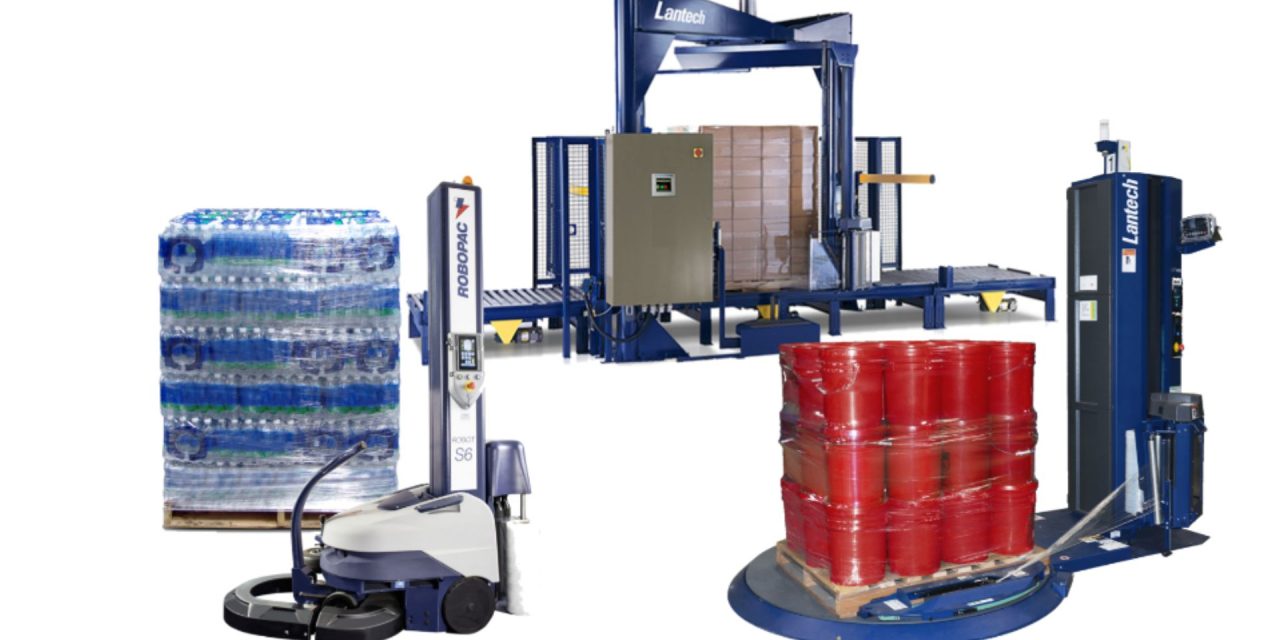
Stretch wrapping brings together several different benefits. Manual wrapping requires a worker to pull film repeatedly around a pallet, often walking backward while bending and reaching. Containment may be around 4 to 6 pounds and can vary from load to load.
An automated wrapper can provide approximately 14 to 15 pounds of consistent containment while stretching the film by roughly 250% before application. Better film utilization reduces material use while higher, more consistent containment improves load stability. In many operations, equipment payback can occur in roughly five to seven months.
These examples also show why automation should not be viewed simply as removing people. Employees can be redirected from repetitive physical work toward activities that cannot, or should not yet, be automated.
Material efficiency multiplies the benefits
Packaging materials and automation are closely connected. Material choice affects direct cost, but also storage, handling, changeovers, transportation and the type of automation that can be used.
Where product-protection requirements permit, one way to think about material efficiency is as a progression toward more compact packaging formats:
Moving along that progression can reduce the amount or cost of packaging material as well as the space required to transport and store it.
Foam, for example, is often bulky. Paper and corrugated alternatives may occupy less space. Pre-made plastic pouches can reduce the packaging footprint further in appropriate applications.
Within flexible packaging, roll film creates another option. Rather than storing inventories of finished pouches, the package is formed around the product and sealed in-line. Larger rolls can support longer production runs, fewer setups and fewer material changeovers.
Those efficiencies continue after the product leaves the packaging line. Right-sizing boxes, bags or envelopes can reduce actual and dimensional weight, improve pallet density and allow more product to fit onto a truck.
That makes packaging efficiency a transportation issue as well. Better use of shipping cube can reduce transportation requirements, fuel consumption and emissions.
Sustainability also includes what happens at the other end of the supply chain. Where the material and application permit, the goal may be packaging that is curbside recyclable, allowing the end user to recycle it without a special collection trip.
Material selection therefore requires looking at several factors together: product protection, material quantity and cost, storage, production efficiency, transportation and disposal.
 Efficiency across the operation
The most visible automation gains are often measured in labour hours or units per minute, but the effects extend further.
A more repeatable process improves consistency from shift to shift. Better ergonomics reduce repetitive lifting and awkward movement. More effective containment improves load stability. Compact packaging reduces warehouse and transportation demands.
Safety is part of the equation as well. In the pump application, reducing the need to manipulate extremely heavy products and work around more hazardous manual processes improved the working environment while increasing output.
Many of these benefits reinforce one another. Less material can mean less storage and transportation. Fewer touches can improve both throughput and safety. Better package sizing can lower freight requirements while leaving the customer with less material to dispose of.
That is the broader opportunity behind packaging automation.
Do more with less: more throughput with fewer touches, better containment with less film, safer work with less repetitive motion, and greater transportation efficiency with less unused space.
For the latest packaging news please visit: https://convertermag.com/category/latest-news/\