

Freemantle’s Automatic Beverage Multipack Machine has played a pivotal role in Belvoir Farm’s move into canning, which has seen the soft drinks manufacturer invest £2m in a state-of-the-art canning line at its Leicestershire on-farm factory. Thanks to the machine’s unrivalled ability to carton virtually any can size into any multipack configuration, the fast and flexible system has enabled Belvoir to embark on an innovation drive that has sent sales of its canned drinks on an upwards trajectory.
Can culture
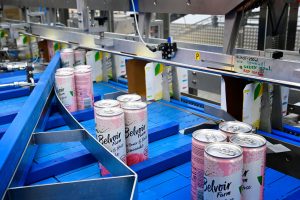 The popularity of the canned RTD (Ready To Drink) format has surged in recent years, on the back of changes in market culture and the rise of conscious consumerism. Light and convenient, cans are perfect for outdoor occasions, which have become a way of life since the pandemic. They are also one of the most sustainable forms of packaging as they can be recycled time and time again.
Whilst the canned RTD market is dominated by alcoholic offerings, there is huge demand for more sophisticated soft options, such as mocktails and botanical sodas. Premium soft drink producer Belvoir Farm had been servicing this market with a range of cans produced by a co-packer. However, by 2022, the company recognised it needed to bring can production in-house to fully capitalise on the canned RTD opportunity.
“Our canned portfolio was growing at such a pace that we needed to invest in in-house production. Up until that point, we hadn’t truly committed to the category,” says Martin Reynolds, head of engineering & project leader at Belvoir.
Ready to innovate
 Belvoir wanted to roll out a number of new lines in canned format to drive the growth of its brand. It had plans to launch its RTD mocktails in 250ml cans alongside a new range of light soft drinks in 330ml slim cans and botanicals in 150ml cans. It also wanted to move into the multipack space, with fridge-friendly four packs (4 x 330ml slim cans) and six-packs (6 x 150ml mixer cans).
“We started looking at equipment for the canning line and when it came to the cartoning machine, the same name kept cropping up in conversation: T. Freemantle,” recalls Martin.
Belvoir invited T. Freemantle to its facility to discuss whether the packaging machinery manufacturer could meet its brief for a format-flexible cartoning machine that could be delivered within a six month timeframe.
A tall order?
“T. Freemantle confirmed everything we were hoping to hear – that their machine could handle all of the can formats we were hoping to run as well as those we might want to introduce in the future, such as 10 or 24 can multipacks for export markets,” says Martin.
“We did look at other machinery manufacturers but they couldn’t compete on timeframe, price, format flexibility, fast and simple cleandown or parts/service availability. We were quoted lead times of up to 12 months and the quotes were much higher as they said they would need to build bespoke systems to accommodate the different formats we wanted to run. T. Freemantle were very confident that a six month lead time from order to delivery was possible,” he adds.
Open or closed carton?
At this stage in the project, Belvoir hadn’t quite finalised what form the multipacks would take. Therefore, it tapped into T. Freemantle’s design studio service, which marries engineering expertise with knowledge of pack styles, materials, glues etc to come up with a design that would be line-compatible, practical and aesthetically appealing.
“Initially we were thinking we wanted an open-sided pack, but T. Freemantle’s advice was that a FEC (Fully Enclosed Carton) would be more viable. They gave us a good steer on what cartonboard would be suitable and pointed us in the direction of Graphic Packaging for designing and printing the cartons. They also recommended a really good glue supplier,” says Martin.
Performing under pressure
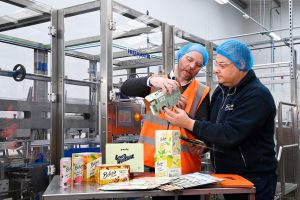 Belvoir placed its order in January and – true to its word – T. Freemantle installed the Automatic Beverage Multipack Machine six months later.
“Time was of the essence as we had already closed the contract with our co-packer so there was massive pressure on the factory to get can production moving again,” recalls Martin.
To ensure the project was delivered within the timescales, T. Freemantle took the unusual step of carrying out the FAT (Factory Acceptance Testing) as part of the installation – demonstrating not only its commitment to the customer but also complete confidence in its technology.
“T. Freemantle were fully aware of the importance of starting can production on the specified date and they pulled out all the stops to make that happen,” says Martin.
Rising to the challenge
High speed packing of beverage cans into smaller cartons is an application that few engineering firms have mastered. It is possible to run four-packs on a machine designed for producing 12 or 24 can multipacks from thicker corrugated board, but the line speeds tend to be unfeasibly slow, which is why many beverage manufacturers resort to hand-packing smaller cartons.
Freemantle has come at this challenge from a different angle, drawing on its expertise in high speed food production lines. Instead of wrapping a blank around a collation of cans and then gluing it, the Automatic Beverage Multipack Machine uses pre-glued cartons, which are picked one at a time from a magazine holder, erected and presented to the can collation. This continuous motion process speeds up the cartoning process considerably.
A gem of a solution
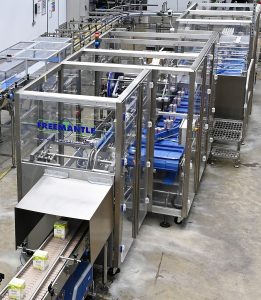 Freemantle’s can collation solution is another unique design feature that sets the Automatic Beverage Multipack Machine apart from the competition and supports high speed performance. An infeed gate system facilitates the efficient release of cans into the machine, where they are guided into a diamond shape that is maintained along the length of the machine until they have been deposited in the open cartons.
“The diamond formation makes it much easier to insert the cans into the cartons than if they were presented square on. It also reduces the risk of snagging on the edges of the cartons,” explains Simon Holt, head of sales (UK & Ireland) at T. Freemantle.
The company’s engineers have also put a lot of thought into the safe passage of cans through the machine – a particular challenge for taller cans and larger collations. The cans are supported throughout the insertion process to ensure can stability is maintained. They have also focused on keeping downtime for cleaning and changeovers to a minimum; can size changeover is simple and easy to perform with no change parts – format changeovers can be executed in as little as 15 minutes.
Fast and flexible
All of these features combine to make the Automatic Beverage Multipack Machine the fastest flexible can cartoning solution on the market today. Belvoir’s minimum line speed requirement – set by the filler – was 12,500 cans per hour, which equates to 50 cartons per minute. Martin reports that the line “easily and consistently” runs at 55 cartons per minute and could potentially reach 70 cartons per minute.
Having this capacity will allow the producer to ramp up its output to keep pace with demand.
In the first six months of operation (June to December 2023), Belvoir produced 1.5 million cans – more than a year’s worth of production under the co-packer arrangement.
“When the figures were presented to our executive board they were really impressed,” says Martin.
2025 target: up to ten million cans
For 2025, Belvoir is targeting between five and ten million cans, produced across several canning campaigns.
“As our canning line currently shares some equipment with our bottling line, we don’t can all the time. We plan a two or three week ‘canning campaign’, usually every other month, based on forecasts,” explains Martin.
The entire project was structured with short term sales targets and a long term goal of achieving payback within five years. To this end, in 2025, the company will invest £2m in new pasteurising and palletising equipment to allow the canning line to run independently, thereby further increasing capacity.
As to whether the project is delivering on its objectives Martin says: “It’s early days, but already we have secured new distribution for our RTD canned launches and are seeing growth from export markets, in particular the US, Australia, Canada, Japan and China. The flexibility afforded by the Automatic Beverage Multipack Machine is invaluable in helping us to adapt to market demands, whether that is producing an extra 10,000 cans or a 10-can pack for a US retailer.”